Save to Pinterest
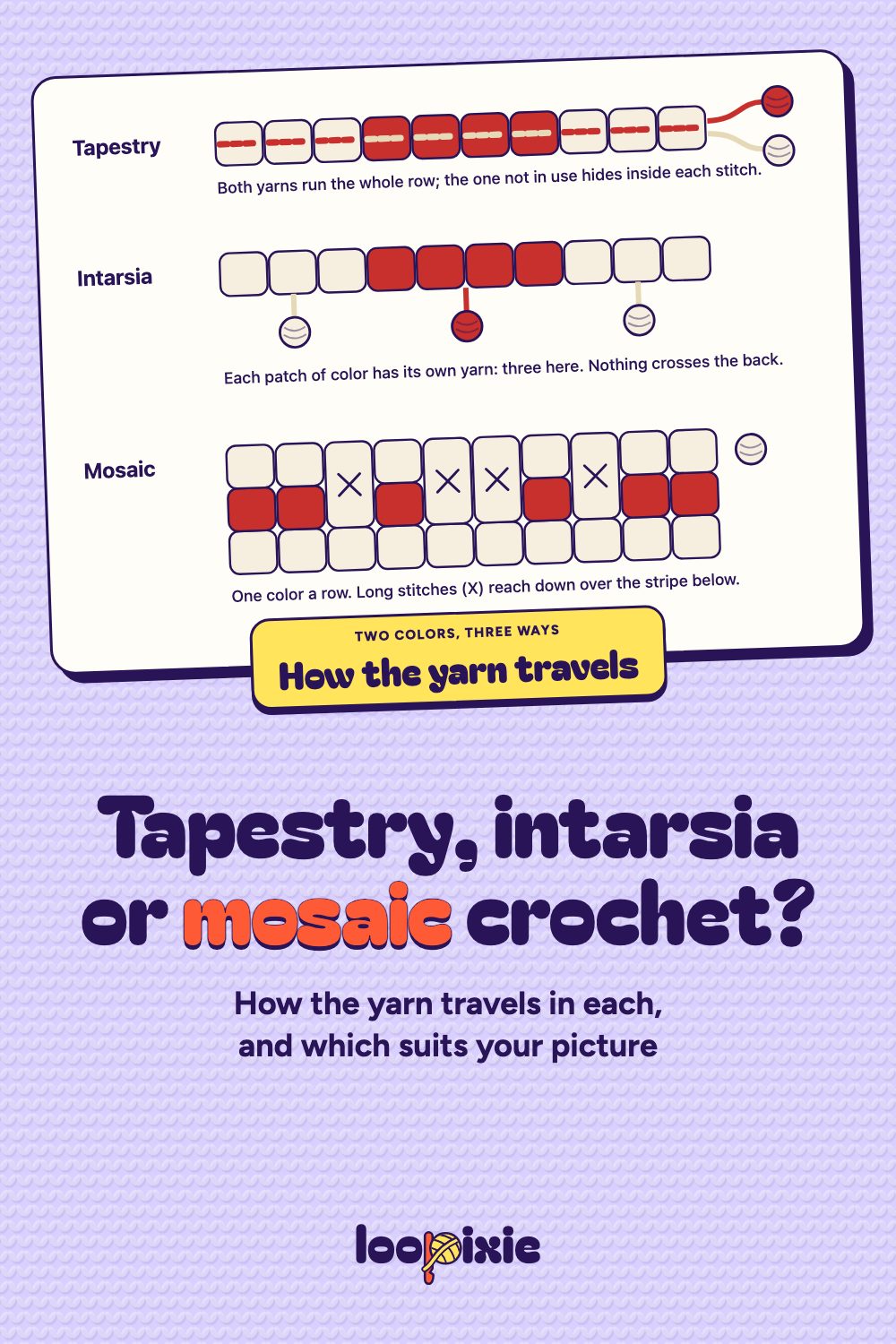
All three put a picture or a pattern into crochet with more than one color. What sets them apart is what happens to the yarn you are not using at the moment:
- Tapestry crochet carries it along inside the stitches, usually across the whole row.
- Intarsia leaves it where it is: each patch of color has its own yarn, and no strand crosses the back.
- Mosaic crochet works one color a row and makes the pattern with long stitches that reach down into the rows below.
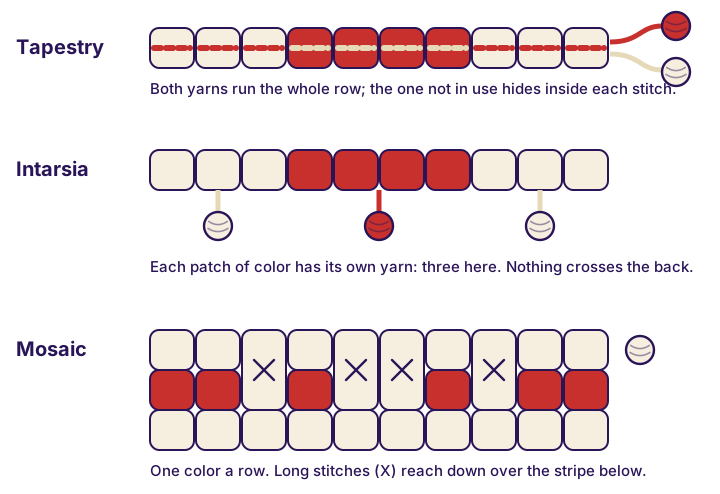 The same small row worked three ways, in red and cream.
Tapestry crochet and intarsia can follow the same chart, with one square per stitch. Mosaic needs a chart drawn for mosaic.
How does tapestry crochet work?
You work one color at a time, usually in single crochet (US terms). The colors you are not using lie along the top of the row below, and you crochet over them, so they sit inside the stitches. To change color, you finish the last stitch of the old color with the new one, and the old yarn goes on inside the next stitches.
- Good for: pictures with many small details and color changes, and motifs that repeat, worked flat or in the round.
- The back: the picture shows on both sides, mirrored on the back. A carried strand can show through between the stitches.
- The fabric: thicker than plain single crochet, because every stitch holds the carried yarn. How firm it feels depends on your tension and on how many colors you carry.
- What to watch: carried yarn showing through, yarns twisting around each other, and pictures that slant a little when worked in the round.
How does intarsia crochet work?
Each patch of color gets its own yarn, often wound on a small bobbin. When you reach the edge of a patch, you change to the next patch’s yarn and leave the old one hanging on the wrong side of the work, ready for the next row. Nothing is carried across. Some crocheters cut the yarn at every change and weave in the ends instead, so patterns differ.
- Good for: big shapes and blocks of color, like a large letter or a simple animal on a plain background.
- The back: it can look neat when the ends are woven in carefully, since no strands cross it. With nothing carried, the fabric is less bulky than tapestry crochet.
- What to watch: the number of yarns. Every separate patch in a row needs its own, so a busy row means many bobbins hanging from your work, and they can tangle.
- Flat or round: in rows you turn, each bobbin waits where you need it on the way back. In the round it takes more planning.
How does mosaic crochet work?
You work one color a row, or a pair of rows, so the piece is built of stripes. The pattern comes from long stitches, often double crochet, that reach down past the stripe below and cover it with the current row’s yarn. There are two main kinds: in overlay mosaic the long stitches sit on top of the fabric, and inset mosaic is usually flatter and lighter.
- Good for: geometric patterns like zigzags, squares, borders and repeating tiles, usually in two colors.
- The back: usually stripes that do not show the pattern.
- Its charts: often mark the long stitches with an X, and the color at the edge of a row shows which yarn that row is worked in. Charts differ, so check the chart’s key.
- Pictures: an ordinary picture chart is not a mosaic chart. A picture usually has to be redesigned for mosaic first.
Which one should I use for a picture?
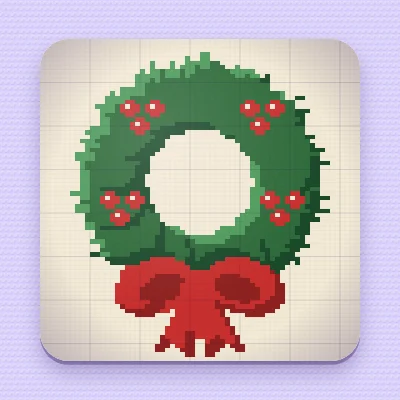
Look at the busiest row of the chart and count its patches of color. We counted on our free Christmas wreath pillow, which is 64 stitches wide. Row 38 crosses the berries and the needles of the wreath: 23 patches of color in one row, in 5 colors.
 Row 38 of the wreath: 23 yarns in intarsia, 5 in tapestry crochet.
In tapestry crochet you work that row with its 5 yarns and carry them along. In intarsia, each of the 23 patches would need its own yarn, all hanging from that one row. Our Santa pillow, one with fewer color changes, still has a row with 13 patches.
So, as a rule of thumb:
- Many small details and frequent color changes: tapestry crochet.
- A few big shapes with long stretches of one color: intarsia.
- A geometric pattern in two colors: mosaic.
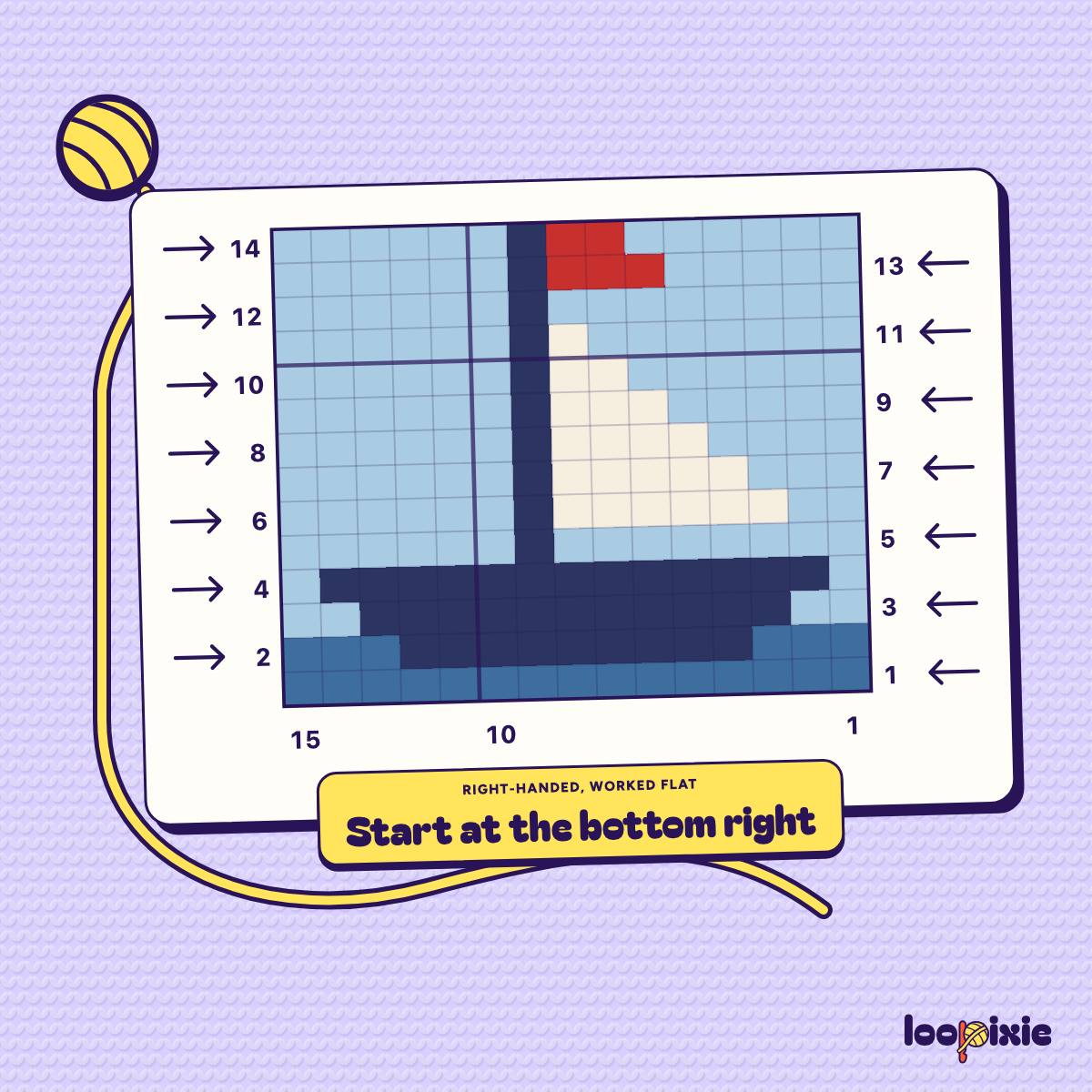
To follow a picture chart in tapestry crochet or intarsia, How to read a tapestry crochet chart shows which way each row goes.
Why do the names get mixed up?
Because the words are used loosely. Some sources list intarsia, mosaic and fair isle among the other names used for tapestry crochet, even while treating them as different techniques. Here we tell them apart by how the yarn travels, which is the clearest way to see the difference.
Two related techniques also cause confusion:
- Stranded or fair isle crochet: the yarn you are not using floats along the back instead of inside the stitches. It suits small repeats, where the floats stay short.
- C2C (corner to corner): a way of building a piece from small diagonal tiles, one tile for each square of the chart. Its color areas are often handled like intarsia, with a yarn for each.
When a pattern uses one of these words, look at how it handles the yarn you are not using. That tells you which technique it means.